

Defending BioShock as a work of philosophical art
The game is cool and most people missed the point

I recently saw a Note thread making the rounds of “Games that are actually philosophically interesting.” In particular I saw C. J. W. Armstrong’s addition:
Well, I was going to put in my 4 titles and call it a day, because this is a topic near and dear to my heart. But… at around the fourth paragraph of explaining my first pick, I realized I should probably just bite the bullet and make a short article.
The game is well renowned, so it might seem odd that I feel any need to defend it, but as with anything popular, you inevitably get a vocal minority questioning that popularity. For a time, I thought they had a point. But after a recent replay, I realized that neither side was really seeing the nuance of the title. Or if they were, they were doing a terrible job of talking about it.1 Either the game was great because “laz e faire capitalism bad” or the game was bad because “that’s not real Objectivism.”
Well, I think the game had much more of interest to say, and I want to speak up for it.
The game, of course, is the 2007 horror shooter, BioShock:
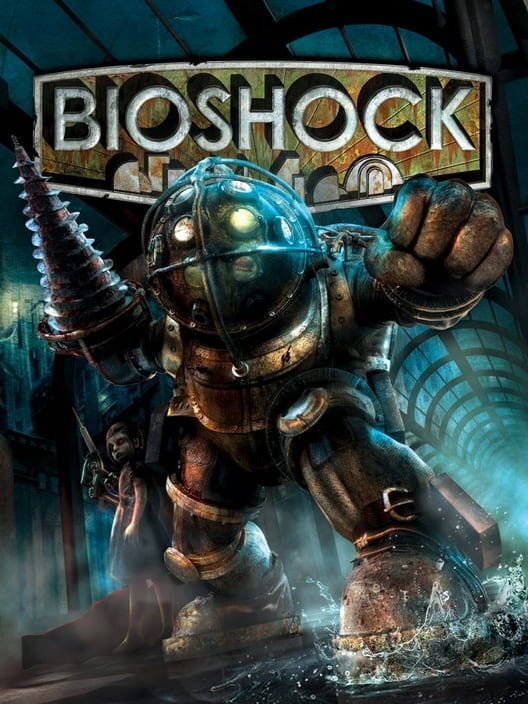
When I was in my libertarian phase, it was cool to dunk on BioShock for “misrepresenting” objectivism through a “cartoonish” oversimplification. I’m not going to restate that whole position (this was supposed to be a short Note originally, after all) but there is some merit to it when looking at only what the game makes obvious.
The game’s opening scene introduces us in dramatic fashion to its underwater metropolis setting, Rapture, and the man at the heart of it, Andrew Ryan. The player is given an account of the founding principles of the city, but it is quite literally the “sales pitch” and is thus intentionally simplified and truncated.
Andrew Ryan is selling newcomers to Rapture on the promise of true sovereignty as an individual. Neither the poor, nor the State, nor even God is entitled to the sweat of your own brow. It is yours and yours alone to do with as your merit allows.
This hyper-individualism, combined with the Atlus Shrugged imagery of the world (and the not so subtle similarity in the names Andrew Ryan and Ayn Rand), it’s clear that the game is critiquing Randian philosophy in some way.
But where I think the point is missed is when the critique centers on the question of whether or not Rapture accurately represents Rand’s philosophy of Objectivism. Because it’s pretty easy to make the case that it doesn’t.
But it isn’t trying to, either.
One of the most well-known free-market positive outlets, Reason, asked Ken Levine himself the question:
Do you view the first BioShock as a critique of Objectivism?
No, I don’t think it is particularly. I never set out to take down Objectivism or libertarians. Just the whole concept of this very interesting worldview: Can you make a better world if you really focus on just yourself and improving yourself?
And the idea, going back to Adam Smith, right? The baker doesn’t bake bread because he wants to help other people; he bakes bread because he wants to make money to feed his family, but when doing so, he feeds the entire community. I just wanted to start with that principle, which is kind of true and brilliant. It’s market economies, and I’m a big believer in market economies.
But then we said, “Well, what if you took the regulatory structure and you just completely destroyed it?”
As Ken explains in the interview, he was inspired by Rand to create a sort of “counter” narrative to Rand’s, but the point he was countering was not her ideals, but the way she tells a story about them. As he says just before the above quote (emphasis mine):
I'm like: "OK, let me see if I can try to tell a Randian-like story, but try to do it where the people are more like people I know, real people who have flaws." But I had no interest in saying, "Oh, screw Objectivism. I'm just going to make fun of it." I really want to engage with it, but how it intersects with real people rather than characters in a book.
And this is exactly what BioShock is. The story of a Randian-esque paragon trying to live out his ideals in the messy intricacies of the “real” world.
Some may (justly) cringe a bit at the idea of this “deconstructivist” sounding objective, as similar notions have been the calling card of a lot of post-modernists. But from the interview and particularly the way Ken talks about Rand’s work, it’s clear he isn’t motivated by disdain for any of her ideas as a post-modernist would. He is doing what any good student of Engineering knows to do, which is stress test your nice ideas to see where the limits lie.
And he also admits (as I suspected) that some of the simplification simply comes from the format:
And of course, it's a video game. If I was writing a novel, I might've used a little more subtlety, but it's a video game. And so—because a player is not reading text on a page, he's engaging in this world, it's a first-person shooter […]
This was 2007. The era of gaming most loudly defined by the Mountain Dew and Doritos gamer. In retrospect, Ken’s studio at the time, 2K Boston, were rather insane for attempting such a philosophically driven, and explicitly political, title—especially on the Xbox 360. The fact that it reached top 3 in sales on the platform at release is nothing short of a miracle, in my opinion.
But I didn’t come here to tell you what Ken says of his own work, interesting as it is. I only bring that up to confirm what was intended. What I wanted to speak on was what I found in the game itself, which seems to fit those intentions.
While the opening cinematic linked above gives the impression that Andrew Ryan is the antagonist of the story, and gives the “crystalized” image he presents of himself and his city, the exploration side of the game as the players gets further in reveals the “real” picture of the man.
Unlike more typical shooters, exploration is essential to the gameplay of BioShock, as necessary resources for survival are scattered about for the player to scavenge. Among them, however, are audio logs which begin to play the moment you pick them up. This is a blasé mechanic now, but at the time it was novel to most of the industry, and BioShock implemented it well (better than most attempts even now).
These audio logs are the player’s view into the past of Rapture and the unfiltered thoughts of its people, including Andrew Ryan. They’re journal recordings, not intended for other ears, but left abandoned for the player to find.
And this is where we see Ken’s sympathy for Ryan and the real people like him. From both Ryan’s own musings and the accounts of people personally familiar with him, the player learns that he was not just the abstract ideal of a man presented in the welcoming film. He is, rather, very much the concrete reality of the American dream: a victim of the Communist revolution in Russia, who eventually fled to America to be free, where he was able to build himself up with a bit of luck, gumption, and wise investments. That was, up until the social programs of the 1930s started and a new threat to his personal business emerged as the government moved to appropriate his wealth for the good of the poor.
His reactions are reasonable, even if they are arguably not the most moral. He is trying to improve himself, only for external forces to bully their way into claiming what is reasonably his. While his troubles in America could be argued to be partly his own fault, it was his scars with the first experience in Russia—which is was completely unjustified—that over-sensitized him to anything that smelled like tyranny of the masses.
This is not a cartoon of an Objectivist. It is somewhat abstracted personality, of course, but a more proper critique of Andrew Ryan as a character might be that he is almost completely unoriginal—at least relative to real history. His flight from Russia story is directly inspired by his namesake, and his experience in America is a story that could be heard from many a biography of a 20th Century entrepreneur. Though, the whole “and then I built a city under water” part is still quite unique… for now.
The point is that Andrew Ryan is not an ideal like a Randian character, but a human who has Randian ideals. Put another way, BioShock is not an examination of Objectivist ideals, but of the Objectivist idealist. We are supposed to identify what is admirable in him in spite of the flaws. It was his ambition and wits that made the impossible dream of Rapture into a reality. And it took an intense stubbornness in those ideals to get that far. But he was, most certainly flawed.
I believe that the opening of the game communicates this spectacularly, as it presents a fallen Rapture, yes, and yet even as it’s falling apart it is absolutely awe-inspiring that it ever existed in the first place. Something was working, for a time.
So what failed? the game asks. Was it inevitable?
That is the question BioShock asks. But many assume the game comes with an answer.
Yet, if you let the game speak for itself, first, piecing together all of the disparate stories of Rapture’s fall as you explore, the more you question what exactly its supposed answer is, until you realize that the game is not trying to convince you of one at all.
One of the best ways to understand what I mean is in the identity of the true and hidden antagonist of the game: Fontaine.
Fontaine is Ryan’s foil and the cause of his city’s downfall. And on the surface, it seems like he’s no different than Ryan, just better at his own game of self-interested and uncompromising ambition. But, as you learn more of what Fontaine was doing in the shadows of Rapture, the more you can make the argument that he’s truly just a thief, through and through, which is exactly the evil Ryan had been trying to fight against his whole life.
So did Ryan compromise his ideals for the lack of his own character? Are Ryan’s ideals only a facade over his own form of theft? Or was he just finally confronted with an evil too great for him to handle? He is, after all, only mortal. A universal truth Fontaine is likewise reminded of in turn, thanks to the player.
Or how about the question of what role Ryan’s paradise played in allowing evil to occur? Did it create evil by eschewing classic morality? Was it sabotaged by outside evils? Did it multiply both good and evil already within its people by chasing an extreme? Was there anything actually unique about its downfall, or was its fate the same shared by all societies, only on an expedited scale?
I have my own opinion on what to make of the evidence presented, but I do think the game provides a basis from which you can discuss these questions from the extreme but (mostly) plausible scenarios it provides. You may think that it doesn’t portray Objectivist philosophy in its best form, but that is a legitimate answer to the question the game poses. As any good scientist knows, even a failed test has great value.
You could say Andrew Ryan just wasn’t Objectivist enough, and now the tale is one of caution about malformed ideas and compromising your values.
You could say Andrew Ryan’s fate was inevitable, because he ignored the downtrodden of Rapture, eventually eroding the society that could have supported him.
What I think is beautiful about BioShock, and makes it a good piece of philosophical art, is that you can find some truth in many perspectives on it simultaneously, while still having your own assumptions challenged if you’re willing to engage with it.
Even for myself, as a Christian very opinionated on right and wrong, I see enough of “the real” in BioShock that you can say it speaks to truth. More truth than falsehood, anyway. Which is a very admirable result for any work of art, I think.
Not that this is unexpected. Whatever overlap exists between students of philosophy and video game enthusiasts has sadly been dominated by post-modernist thought for most of the medium’s history. There is some hope this is finally changing soon.
Bioshock is a great choice for a philosophically rich game. It’s somewhat forgotten now, which is a shame, because you’re right that it has a lot to say about whether or not an Objectivist utopia could ever be viable—and who, or what, is exactly to blame for everything going wrong in Rapture. I really liked how you pointed out that we’re meant to see Ryan as an Objectivist idealist rather than a pure embodiment of Randian philosophy. I haven’t thought of it in quite those terms, but I agree; it’s more nuanced than maybe I’d really considered! Ryan is a human being first and foremost, trying to build a society based on Objectivist values. Picking apart how much of the city’s failure is due to his own flaws versus the flaws of Objectivism itself it a really interesting way to analyze the game!